
When people think about mediation, they often ask:
-
“Should I settle?”
-
“Do I have a strong case?”
-
“What are my chances at trial?”
-
“Am I giving up too much?”
These are not emotional questions. They are risk questions.
The truth is this: mediation works best when both sides understand their litigation risk. Without that clarity, negotiations stall. With it, settlement becomes strategic — not a sign of weakness.
At SoCal Mediation Center, we use the Harvard Negotiation Model to help parties evaluate risk before and during mediation. The framework is structured, practical, and surprisingly empowering.
Here's how it works.

Why Most People Misjudge Litigation Risk
Before we get into the framework, it's important to understand a common problem.
Most people evaluate their case based on:
-
How wronged they feel
-
How confident their attorney sounds
-
What friends or family think
-
A few online verdicts they've seen
But courts don't decide cases based on who feels more justified.
They decide cases based on:
-
Burden of proof
-
Credibility
-
Admissible evidence
-
Legal standards
-
Judicial discretion
There is always uncertainty.
The Harvard model helps bring structure to that uncertainty.
Step One: Identify Your BATNA
One of the central ideas from the Harvard Program on Negotiation is BATNA — your Best Alternative to a Negotiated Agreement.
In plain terms, this means:
What happens if you do not settle?
For someone involved in a lawsuit, your BATNA is typically trial — or at least continued litigation.
But that answer is too simplistic. You need to dig deeper.
Ask yourself:
-
What does “winning” actually look like?
-
How long will it take?
-
What will it cost?
-
Can the other side pay if I win?
-
What are the chances of appeal?
For example, in a real estate partition dispute:
-
Your BATNA may be a court-ordered sale.
-
But the process could take 12–24 months.
-
Legal fees could consume much of the equity.
-
The property might sell below expectations.
That changes the analysis.
Also Consider Your WATNA
The Harvard model also looks at the WATNA — Worst Alternative to a Negotiated Agreement.
What is your worst realistic outcome?
-
Losing at trial
-
Paying the other side's attorney's fees
-
Being ordered to sell at an unfavorable time
-
Having your credibility questioned by a judge
Even strong cases carry risk.
And the MLATNA
There is also the Most Likely Alternative to a Negotiated Agreement.
This is often where reality lives.
The most likely outcome in litigation is not total victory or total defeat. It's something in between:
-
Partial success
-
Reduced damages
-
Unexpected rulings
-
Settlement on courthouse steps after significant fees
When you look at BATNA, WATNA, and MLATNA honestly, the question shifts from “Should I fight?” to:
“Is the risk and cost of fighting worth it?”
That is the beginning of productive mediation.
Step Two: Use Objective Criteria
Another core principle of the Harvard model is reliance on objective criteria.
In other words:
What neutral standards will the court apply?
This is where many people overestimate their position.
Courts do not decide cases based on fairness in the abstract. They apply specific legal standards.
Some examples:
-
Who has the burden of proof?
-
What elements must be proven?
-
Is there a statute of limitations issue?
-
Is there an attorney's fee statute?
-
Does the judge have discretion?
-
What is the standard of review on appeal?
In mediation, we often step back and ask:
-
What evidence supports each element?
-
What documents are admissible?
-
What witness testimony is reliable?
-
How would a neutral judge likely interpret this contract?
Objective criteria help remove ego from the equation.
Instead of:
“I know I'm right.”
The question becomes:
“Can I prove it under the legal standard that applies?”
That shift alone often moves cases toward resolution.
Step Three: Reality Testing
The Harvard approach also emphasizes “reality testing.”
Reality testing is not about discouraging you. It is about protecting you.
In mediation, reality testing means asking careful questions:
-
What if the judge sees this differently?
-
What if your key witness struggles under cross-examination?
-
What if the court excludes this piece of evidence?
-
What if attorney's fees shift?
-
What if this takes another year?
These are not negative questions. They are strategic ones.
As a mediator, my role is not to push settlement at all costs. It is to help both sides fully understand their litigation risk — so any agreement is informed, not pressured.
When both parties engage in honest reality testing, negotiation becomes grounded and rational.

The Hidden Costs of Litigation Most People Overlook
Evaluating risk is not just about who wins.
It is about total exposure.
Here are risks people often underestimate:
Time Risk
Litigation can take years. Delays increase stress and financial uncertainty.
Fee Risk
Even if you win, your legal fees may not be fully recoverable.
Emotional Risk
Depositions, discovery, and public court proceedings are stressful and intrusive.
Collection Risk
Winning a judgment is not the same as collecting it.
Appeal Risk
A favorable ruling can be reversed.
When these risks are layered into the BATNA analysis, settlement often becomes a strategic option rather than a compromise of principle.
How This Framework Helps You Decide Whether to Hire a Mediator
If you are considering mediation, ask yourself:
-
Do I clearly understand my BATNA?
-
Have I honestly evaluated my worst-case scenario?
-
Am I relying on objective legal standards?
-
Have I considered time, cost, and emotional exposure?
-
Have I tested how a neutral decision-maker might view this?
If the answer to any of these is “not really,” mediation may be especially valuable.
Mediation is not about giving in. It is about gaining clarity.
When you understand your litigation risk, you negotiate differently:
-
You focus on outcomes, not arguments.
-
You prioritize certainty.
-
You weigh timing strategically.
-
You avoid escalation that benefits no one.
Mediation Works Best When Both Sides Are Informed
The most successful mediations share one thing in common:
Both parties have a realistic understanding of their litigation risk.
When one side is operating from overconfidence or fear, settlement is difficult.
When both sides understand:
-
What could happen
-
What is likely to happen
-
And what it will cost to find out
Resolution becomes achievable.
Settlement Is Not Weakness — It Is Strategy
There is a misconception that settling means backing down.
In reality, strategic settlement often reflects strength.
It shows:
-
Clear risk assessment
-
Long-term thinking
-
Control over outcome
-
Cost management
-
Emotional discipline
Trial transfers control to a judge or jury.
Settlement keeps control in your hands.
A Simple Litigation Risk Self-Assessment
Before mediation, consider writing down:
-
My best realistic outcome is: __________
-
My worst realistic outcome is: __________
-
My most likely outcome if we continue is: __________
-
Estimated additional legal fees: __________
-
Estimated time to resolution: __________
-
What certainty is worth to me: __________
Seeing this in writing often changes perspective.
Final Thoughts
Every lawsuit involves uncertainty.
The Harvard negotiation model does not eliminate risk — it clarifies it.
When you understand your BATNA, apply objective standards, and engage in honest reality testing, you make decisions from strength rather than emotion.
Mediation is most effective when it is informed by that clarity.
If you are considering mediation in a real estate dispute, probate matter, business conflict, or civil litigation case, the first step is not compromise.
It is evaluation.
When risk is understood, resolution becomes possible.
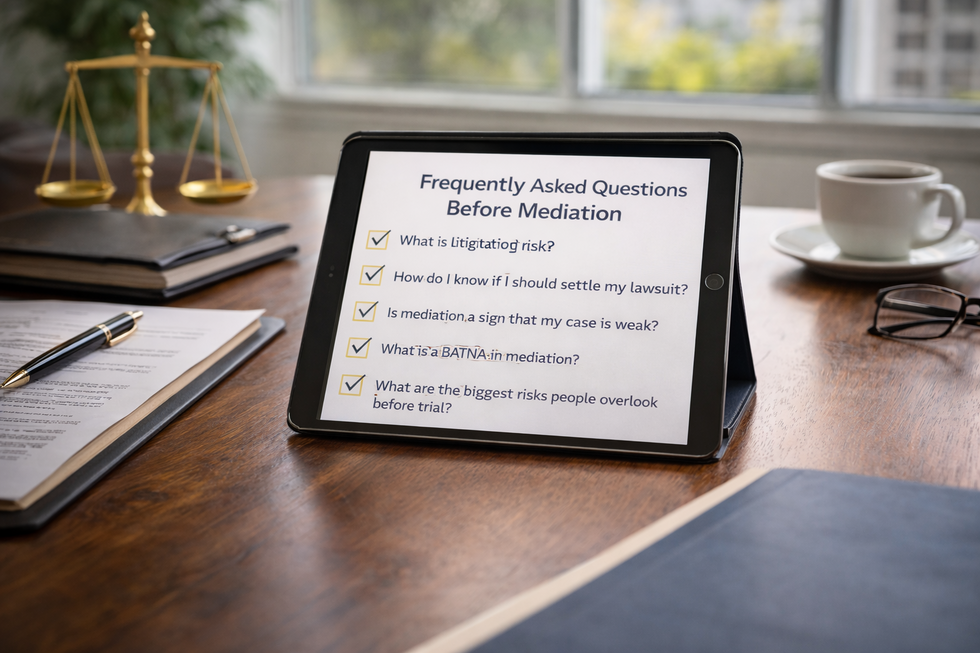
Frequently Asked Questions About Litigation Risk and Mediation
What is litigation risk?
Litigation risk is the uncertainty involved in taking a dispute to trial. Even strong cases carry risk because outcomes depend on burden of proof, admissible evidence, witness credibility, judicial discretion, and appeal possibilities. Evaluating litigation risk helps you understand not just whether you might win, but what it could cost in time, money, and stress.
How do I know if I should settle my lawsuit?
You should consider settling if your most likely outcome at trial does not clearly outweigh the cost, delay, and uncertainty of continued litigation. A structured evaluation of your best case, worst case, and most likely outcome often clarifies whether settlement is strategically sound.
Is mediation a sign that my case is weak?
No. Mediation is not a sign of weakness. It is a strategic decision to control risk. Many strong cases settle because the parties prefer certainty over uncertainty. Settlement allows you to control timing, terms, and cost instead of placing the decision in the hands of a judge or jury.
What is a BATNA in mediation?
BATNA stands for “Best Alternative to a Negotiated Agreement.” In litigation, your BATNA is typically continuing to trial. Evaluating your BATNA means honestly assessing what will likely happen if the case does not settle. Understanding your BATNA helps you negotiate from a position of clarity rather than emotion.
What are the biggest risks people overlook before trial?
Commonly overlooked risks include:
-
Attorney's fee exposure
-
Delays in court scheduling
-
Unpredictable evidentiary rulings
-
Witness credibility problems
-
Collection difficulties after judgment
-
The possibility of appeal
These risks often shift the strategic value of settlement.
Does mediation work in high-conflict disputes?
Yes. Mediation can be particularly effective in high-conflict real estate, probate, and business disputes. When both sides engage in structured risk evaluation, even emotionally charged cases can move toward resolution.
How long does mediation take compared to litigation?
Mediation can often resolve disputes in a single day or a few sessions. Litigation in California courts may take one to three years or more, depending on complexity and court congestion. Time itself is a form of litigation risk.
Can mediation happen before a lawsuit is filed?
Yes. Mediation can occur before or after a lawsuit is filed. In fact, early mediation can significantly reduce legal costs and preserve relationships before positions become entrenched.
What if the other side refuses to be realistic?
A skilled mediator uses structured reality testing and objective legal standards to help both sides evaluate risk. While no mediator can force agreement, informed discussion often leads to progress where argument alone does not.
What types of cases benefit most from litigation risk analysis?
Litigation risk analysis is especially valuable in:
-
Real estate disputes and partition actions
-
Probate and trust conflicts
-
Business partnership disputes
-
Contract litigation
-
Civil disputes involving attorney's fees
In these cases, risk exposure can significantly affect financial outcomes.
Comments
There are no comments for this post. Be the first and Add your Comment below.
Leave a Comment