
If you are considering divorce but want to avoid a courtroom battle, you may be wondering whether mediation is the right fit for your case. The truth is that divorce mediation works very well for many California couples, but not for all of them. The key is understanding the kinds of cases that are best suited for mediation and the situations where mediation can help people reach durable, fair, and cost-effective solutions.
At SoCal Mediation, many people contact us after realizing they do not want a divorce process driven entirely by court hearings, attorney conflict, and escalating expense. They want a process that is more private, more respectful, and more focused on practical problem-solving. In the right case, divorce mediation can provide exactly that.
This guide explains when divorce mediation works best in California, what makes a case a strong fit for mediation, and how to tell whether your situation is likely to benefit from a mediated approach.

What Is Divorce Mediation?
Divorce mediation is a structured process in which a neutral third party helps spouses resolve the issues involved in their divorce. Those issues may include property division, parenting plans, child support, spousal support, allocation of debts, and other financial or family-related concerns.
A mediator does not act as a judge and does not represent either spouse. Instead, the mediator helps both people communicate, identify the real issues, exchange necessary information, and work toward agreement.
For many California couples, the appeal of mediation is simple. It allows them to stay in control of important life decisions rather than handing those decisions over to a judge who knows very little about their family beyond what is presented in court papers and testimony.
Why Some Divorce Cases Are Better for Mediation
Not every divorce needs to become a fight. Many couples are not looking for revenge or vindication. They are looking for a practical way to end the marriage, protect their children, divide their assets fairly, and move forward.
Mediation works best when the spouses are willing to participate in that kind of process. The parties do not need to agree on everything. In fact, most people who come to mediation have real disagreements. What matters is whether they are capable of working through those disagreements in a setting designed to reduce conflict and encourage resolution.
When that happens, mediation can save substantial time, money, stress, and emotional damage.
1. Divorce Mediation Works Best When Both Spouses Want to Resolve the Case
The strongest mediation cases usually involve two people who both understand that the marriage is ending and want to resolve things in a constructive way.
This does not mean they are getting along well. It does not mean they trust each other fully. It does not mean the divorce is easy. It simply means that both people are willing to engage in a process aimed at settlement rather than escalation.
If one spouse is truly committed to resolution, but the other spouse is focused only on punishment, delay, or domination, mediation becomes more difficult. But when both people want a solution, mediation can be highly effective even in emotionally difficult cases.
2. Mediation Often Works Very Well in Cases Involving Children
For many families, mediation is especially valuable when the divorcing couple has children. That is because parents are not just ending a marriage. They are restructuring a family.
Litigation often pushes parents into rigid positions. One parent asks for one thing, the other parent opposes it, and the dispute grows. Mediation allows parents to have a more thoughtful conversation about schedules, communication, decision-making, holidays, transportation, and the specific needs of their children.
A judge may have only limited time to hear the facts and may issue orders that are necessarily broad or standardized. In mediation, parents can create a more customized parenting plan that fits the reality of their family.
That often makes mediation a better long-term option, especially when the parents will need to co-parent for years after the divorce is final.
3. Mediation Is a Good Fit When Privacy Matters
Divorce often involves sensitive information. Financial records, business interests, family problems, parenting concerns, and personal history may all become part of the process.
Court litigation is public. Mediation is private.
That privacy can be especially important for business owners, professionals, public-facing individuals, and families who simply do not want every disagreement turned into a public court dispute. It can also make it easier for spouses to speak more openly and creatively about possible solutions.
When privacy matters, mediation is often far more appealing than traditional litigation.
4. Mediation Works Best When the Parties Want More Control Over the Outcome
One of the greatest advantages of mediation is that the parties keep control over the final terms of their agreement.
In a litigated divorce, the judge decides the disputed issues if the parties cannot settle. In mediation, the spouses decide whether to agree and what terms are acceptable. That control matters because divorce is not just about legal rules. It is also about practical realities.
Families may have unique work schedules, special parenting needs, unusual property arrangements, or financial concerns that do not fit neatly into a standard court order. Mediation gives spouses the opportunity to craft solutions that work in real life, not just on paper.
For many people, that sense of control is one of the biggest reasons mediation succeeds.
5. Mediation Is Often Ideal for Couples Who Want to Reduce Cost
California divorce litigation can become expensive very quickly. Once both sides retain attorneys for full representation, the cost of correspondence, pleadings, court appearances, discovery, motions, and trial preparation can climb fast.
Mediation is often much more cost-effective because the parties are paying a neutral to help them solve problems rather than paying two advocates to battle over every issue. That does not mean mediation is free or that every mediated case is simple. But in many situations, it is significantly less expensive than full litigation.
This can be especially important when the parties would rather spend their resources on establishing separate households, supporting their children, or preserving marital assets rather than depleting those assets in legal fees.
6. Mediation Can Work Well Even in Cases With Moderate Conflict
A common misconception is that mediation only works for couples who get along. That is not true.
Many mediation cases involve frustration, hurt feelings, mistrust, and communication problems. Those issues do not automatically make mediation inappropriate. In fact, mediation is often most useful precisely because communication has broken down and the parties need a structured environment to move the conversation forward.
What matters is not whether conflict exists. Conflict almost always exists. What matters is whether the conflict can be managed productively enough for decision-making to occur.
If both spouses are willing to listen, respond, exchange information, and consider options, mediation can still work even when the relationship is strained.
7. High-Asset Cases Can Be Good Candidates for Mediation
Some people assume that mediation is only for simple cases. That is not accurate.
Many high-asset California divorces are well suited for mediation, particularly when the parties want privacy, efficiency, and more control over how financial issues are handled. Cases involving real estate, investment accounts, retirement assets, business interests, and support issues can often be mediated successfully.
In those situations, mediation may work best when paired with outside professionals such as accountants, financial neutrals, appraisers, or review attorneys. That kind of supported mediation process can be very effective because it combines informed financial analysis with a settlement-focused environment.
For people with substantial assets, mediation is often not a shortcut. It is a smarter and more strategic process.
8. Mediation Works Best When Both Spouses Are Willing to Exchange Information Honestly
A successful mediation depends on informed decision-making. That means both spouses must be willing to disclose the facts, especially financial facts, in a reasonably transparent way.
Mediation does not work well when one spouse is hiding assets, concealing income, refusing to produce records, or intentionally manipulating the process. But when both people are willing to exchange bank statements, account information, debt information, and other relevant records, mediation becomes much more effective.
Transparency is one of the foundations of a fair mediated agreement.
9. Mediation Is a Strong Option for People Who Want a More Respectful Process
Some people come to mediation not because their case is easy, but because they want to avoid making it worse.
They may want to protect the children from conflict. They may want to preserve a workable post-divorce relationship. They may want to avoid the emotional damage that often comes from hostile litigation. Or they may simply want to be treated like a person rather than a case file.
Mediation allows people to address difficult issues in a more respectful setting. That does not eliminate hard conversations. It does, however, change the framework in which those conversations happen.
For many families, that makes a major difference.
10. Mediation Often Works Best When Combined With Legal Review
Some of the best mediation cases involve a balanced approach. The spouses mediate the issues with a neutral, but each spouse also has the option of consulting with an independent attorney before signing a final agreement.
This can be especially helpful in cases involving support, retirement issues, real estate, separate property claims, business interests, or any issue where one or both spouses want added legal guidance. Mediation with legal review often gives people greater confidence that the process is both efficient and informed.
In California, that hybrid model is often one of the smartest ways to handle divorce.
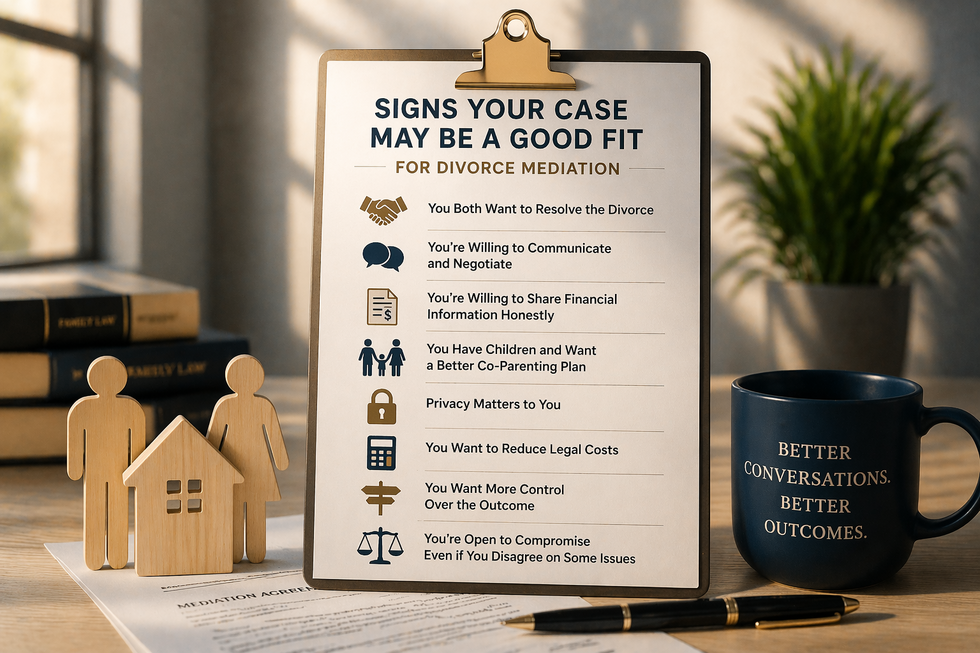
Signs Your Case May Be a Good Fit for Divorce Mediation
You may be a good candidate for mediation if:
you and your spouse both want to resolve the divorce
you want to avoid a prolonged court fight
you have children and want a better co-parenting foundation
you value privacy
you want more control over decisions
you are both willing to exchange information
you want to reduce legal fees
you are open to compromise, even if difficult issues remain
You do not need a perfect relationship for mediation to work. You need enough willingness, honesty, and participation to make constructive negotiation possible.
When Mediation May Need More Support
Even cases that are generally good candidates for mediation may still need additional professional support. Sometimes that means legal review. Sometimes it means bringing in a financial neutral, appraiser, or tax professional. Sometimes it means structuring the sessions carefully because emotions are high.
That does not mean mediation has failed. It means the process is being adapted to fit the needs of the case.
The best mediation process is not one-size-fits-all. It is thoughtful, informed, and responsive to the realities of the family involved.
Final Thoughts: Is Your Divorce a Good Fit for Mediation?
Divorce mediation works best in California when both spouses are prepared to participate in good faith, exchange information, and work toward practical solutions. It is especially effective in cases involving children, privacy concerns, cost sensitivity, and a desire for more control over the outcome.
Mediation does not require perfect agreement. It does not require friendship. And it does not require a simple case. What it requires is enough willingness on both sides to engage in a settlement process rather than a legal war.
At SoCal Mediation, we believe many people are better served by a divorce process that is private, informed, solution-oriented, and tailored to the needs of the family. For the right case, mediation can provide that path.
If you are wondering whether your divorce is a good fit for mediation, the answer often begins with one question: are both of you willing to work toward a fair resolution rather than fight for total victory?
If the answer is yes, mediation may be exactly where you should start.
If you want, I can next do the full Article 3 of 3: When You Should Hire a Divorce Lawyer Instead of Using Mediation.

Questions and Answers About When Divorce Mediation Works Best in California
When does divorce mediation work best?
Divorce mediation works best when both spouses are willing to participate in good faith, exchange information honestly, and work toward a practical resolution. The parties do not have to agree on everything at the start, but they do need enough willingness to communicate and compromise. Mediation is often most effective when both people want to avoid a drawn-out court battle and prefer a more private, respectful process.
Is divorce mediation a good idea if we have children?
Yes, in many cases divorce mediation is especially helpful when children are involved. Mediation allows parents to create parenting plans based on the actual needs of their children instead of relying on a more general court order. It can also help reduce conflict and build a stronger co-parenting foundation after the divorce is final.
Can divorce mediation work if we do not get along?
Yes. A common misconception is that mediation only works for couples who are friendly or in full agreement. In reality, many people come to mediation because communication has broken down and they need a structured setting to work through difficult issues. Mediation can still work well when there is conflict, as long as both spouses are capable of participating productively.
Is divorce mediation only for simple divorce cases?
No. Divorce mediation can work in both simple and complex cases. Some high-asset divorces involving real estate, retirement accounts, businesses, and support issues are excellent candidates for mediation, especially when the spouses want privacy and efficiency. In more complex cases, mediation can be supported by outside professionals such as financial neutrals, appraisers, or review attorneys.
Is mediation better than going to court for divorce in California?
For many couples, yes. Mediation is often faster, more private, and less expensive than litigation. It also gives spouses more control over the outcome. However, mediation is not always the best option if there is domestic violence, serious dishonesty about finances, or a major power imbalance between the spouses.
What makes someone a good candidate for divorce mediation?
A good candidate for divorce mediation is someone who wants to resolve the divorce without unnecessary conflict, is open to compromise, and is willing to exchange financial and other relevant information. Mediation is often a good fit for people who value privacy, want to reduce legal fees, and prefer to make their own decisions instead of having a judge decide for them.
Can we use mediation and still talk to our own lawyers?
Yes. In fact, that is often a very smart approach. Many couples use mediation to resolve the issues in their divorce, then have independent attorneys review the final agreement before signing. This allows the parties to benefit from the lower-conflict structure of mediation while still receiving individual legal advice.
Does mediation help lower divorce costs?
In many cases, yes. Mediation is often more cost-effective than full litigation because the parties are working with one neutral professional instead of paying two lawyers to fight every issue in court. While every divorce is different, mediation can often save substantial money when both spouses are committed to resolution.
Is mediation confidential in California divorce cases?
Yes, mediation is generally private and confidential, which is one of its major advantages. Many people prefer mediation because it keeps sensitive family, financial, and parenting issues out of the public courtroom process. That privacy can make it easier for spouses to speak openly and work toward settlement.
When should divorce mediation not be used?
Mediation may not be appropriate when one spouse is using intimidation, hiding assets, refusing to disclose information, or trying to control the process unfairly. It may also be inappropriate in cases involving domestic violence or situations where one spouse does not feel safe participating. In those cases, direct legal representation may be the better path.
Related Reading: Divorce Mediation vs. Divorce Lawyer in California
Want to understand how mediation compares to legal representation? Read our companion article, Divorce Lawyer vs. Divorce Mediation where we explain the differences between the two processes, the pros and cons of each, and how to choose the right approach for your divorce.
Comments
There are no comments for this post. Be the first and Add your Comment below.
Leave a Comment