

Divorce is rarely just a legal event. For most couples, it is an emotional, financial, social, and legal transition that unfolds over time. Yet in Los Angeles, many people still believe that divorce automatically means hiring aggressive lawyers, filing motions, and fighting in court—often at enormous emotional and financial cost.
For couples seeking a more respectful, private, and cost-effective alternative, divorce mediation offers a different path. And for Spanish-speaking families in Los Angeles, working with a bilingual mediator who understands cultural values, family dynamics, and communication styles can make all the difference.
This article explains how divorce mediation works, why it is often a better option than litigation, and why a conciliatory, Spanish-speaking divorce mediator in Los Angeles can help families move forward with dignity instead of conflict.
Divorce Is Not Just One Process — It's Four
One of the most important insights from modern divorce mediation is that divorce is not a single event. It is actually four overlapping processes, each of which affects the others:
-
The emotional divorce
-
The social divorce
-
The financial divorce
-
The legal divorce
When these four divorces are handled out of sync—especially when the legal divorce moves too fast—the result is often unnecessary conflict, delay, and long-term harm. Mediation is designed to slow the process down just enough to allow thoughtful decisions, while still moving things forward efficiently.
The Emotional Divorce: Why Timing Matters
The emotional divorce begins when one spouse decides the relationship is over and ends when both spouses accept that reality. Importantly, spouses are often at very different emotional stages.
One spouse may be ready to move on. The other may still be in shock, denial, or anger. When the legal process moves forward without recognizing this imbalance, negotiations can break down quickly.
In mediation, emotional timing is respected. A skilled mediator understands that productive decision-making requires emotional readiness. This does not mean avoiding hard conversations—it means having them at the right time, in a controlled, respectful setting.
For Spanish-speaking clients, this is especially important. Cultural values around marriage, family unity, and extended family involvement often intensify the emotional side of divorce. A bilingual mediator who understands these dynamics can help prevent emotional conflict from spilling into legal warfare.
The Social Divorce: Family, Friends, and Community Pressure
Divorce affects more than just the couple. Family members, friends, and even coworkers may feel compelled to take sides. In close-knit communities—common in many Latino families—this pressure can be intense.
Court litigation often amplifies these tensions. Accusations become part of the public record. Temporary orders fuel resentment. Family members may bankroll litigation or encourage extreme positions.
Mediation, by contrast, keeps decision-making between the people who matter most: the spouses themselves. It allows couples to discuss family concerns openly, including cultural or religious considerations, without turning them into legal weapons.
In some cases, mediation can even include structured conversations about extended family involvement—something courts simply do not do.
The Financial Divorce: Better Decisions Outside the Courtroom
Financial decisions are often the most consequential—and the most expensive—part of divorce. Property division, support, debt allocation, and future planning can shape both spouses' lives for decades.
In court, judges are limited. They must apply statutory rules, even if the result makes little practical sense. Judges cannot be creative. They cannot structure nuanced tax-saving solutions. They cannot tailor outcomes to a family's real-world needs.
Mediation allows couples to:
-
Exchange financial information voluntarily
-
Use neutral experts jointly (saving thousands in fees)
-
Explore creative solutions unavailable in court
-
Address tax consequences proactively
-
Preserve assets instead of spending them on legal fees
For families with modest to moderate assets—a large segment of Los Angeles households—this can mean the difference between financial stability and long-term hardship.
The Legal Divorce: Keeping It Simple and Uncontested
Ironically, the legal divorce is often the simplest part—if the other three divorces are handled correctly.
An uncontested divorce typically requires:
-
Filing the initial paperwork
-
Serving or acknowledging receipt
-
Submitting a settlement agreement
-
Obtaining a judge's approval
In mediation, the legal process becomes a formality, not a battlefield. The agreement is reached first. The court simply signs off.
In litigation, the legal divorce often takes over everything. Discovery disputes, temporary orders, hearings, and trials can drag on for months or years—frequently leaving both spouses worse off than if they had settled earlier.
Mediation vs. Litigation: Two Very Different Paths
Litigated divorce is adversarial by design. Lawyers are trained to advocate aggressively. Procedures reward escalation. Communication is filtered through pleadings and declarations that often inflame rather than resolve conflict.
Mediation operates differently:
-
It is non-adversarial
-
The spouses speak for themselves
-
The mediator facilitates, not decides
-
Information is shared voluntarily
-
Solutions are negotiated, not imposed
This difference is especially important for couples who must continue interacting after divorce—particularly parents.
Why Conciliatory Divorce Matters for Children
Research consistently shows that children are harmed not by divorce itself, but by ongoing parental conflict.
Court battles expose children to years of tension, hostility, and instability. Mediation focuses on reducing conflict early, creating parenting plans that emphasize cooperation rather than control.
For bilingual and bicultural families, mediation also allows parents to address language use, cultural traditions, and extended family roles in parenting—issues courts rarely consider meaningfully.
Virtual Divorce Mediation in Los Angeles
Post-pandemic, virtual mediation has become a permanent option. Many Los Angeles couples now prefer remote mediation for convenience, privacy, and flexibility.
Virtual mediation:
-
Reduces scheduling delays
-
Eliminates courthouse stress
-
Allows participation from different locations
-
Works well for high-emotion conversations when managed properly
Spanish-speaking mediation sessions can be conducted entirely in Spanish, or bilingually, ensuring clarity and reducing misunderstandings that often arise when legal concepts are discussed in a second language.
Who Is Divorce Mediation Best For?
Divorce mediation is particularly well-suited for couples who:
-
Want to avoid court
-
Value privacy and dignity
-
Are willing to negotiate in good faith
-
Want to control costs
-
Need culturally sensitive communication
-
Prefer a Spanish-speaking professional
-
Want solutions tailored to their family
Even couples who are currently in conflict can benefit—mediation does not require agreement at the outset, only a willingness to try a different process.
The Role of a Spanish-Speaking Divorce Mediator in Los Angeles
Language is more than words. It is culture, tone, nuance, and trust.
A Spanish-speaking divorce mediator can:
-
Ensure both spouses fully understand the process
-
Reduce power imbalances caused by language barriers
-
Address cultural expectations directly
-
Improve communication quality
-
Prevent misunderstandings that escalate conflict
In Los Angeles, where Spanish-speaking households are a significant part of the community, bilingual mediation is not a luxury—it is often essential to a fair and effective process.
Choosing a Better Way Forward
Divorce is never easy. But it does not have to be destructive.
Mediation offers couples the opportunity to:
-
Make informed decisions
-
Preserve assets
-
Protect children
-
Maintain dignity
-
Move forward with clarity rather than regret
For those seeking a conciliatory divorce mediator in Los Angeles, especially one who speaks Spanish and understands cultural dynamics, mediation provides a powerful alternative to the traditional court-driven model.
If you are considering divorce and want to explore a respectful, cost-effective, and culturally informed approach, divorce mediation may be the path that allows you to end one chapter—and begin the next—without unnecessary damage.
Q&A
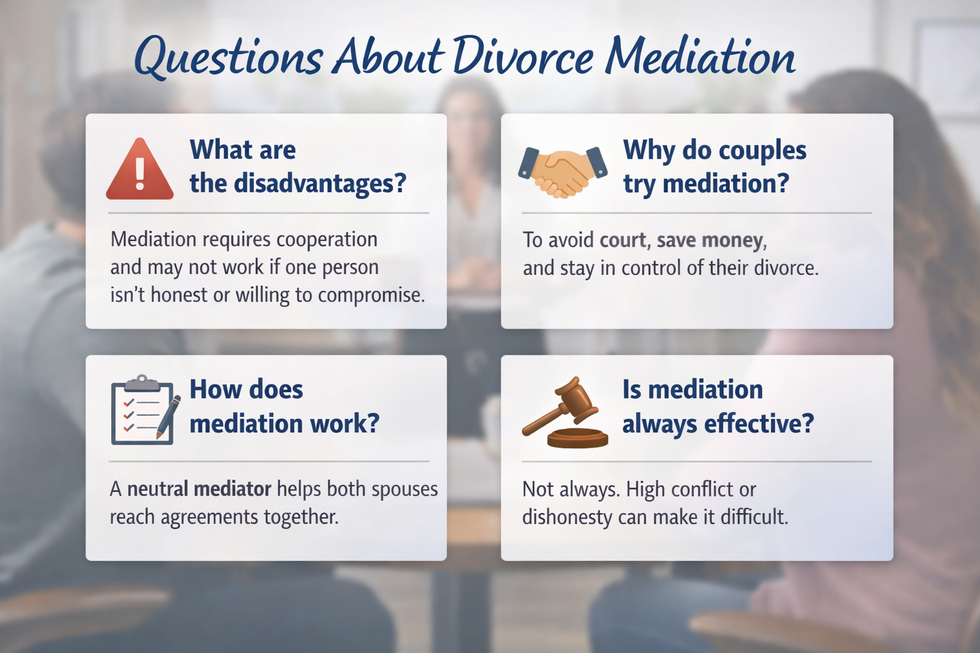
What are the disadvantages of divorce mediation?
Divorce mediation requires both spouses to participate in good faith. It may not be effective if one spouse refuses to cooperate, disclose information, or compromise. Mediation also does not involve a judge making decisions, which some people prefer in high-conflict or urgent situations.
Why do couples go to divorce mediation?
Couples go to divorce mediation to avoid court, reduce costs, maintain privacy, and keep control over decisions. Mediation allows spouses to resolve issues cooperatively rather than through adversarial litigation, which often saves time, money, and emotional strain.
How does mediation work in divorce?
In divorce mediation, a neutral mediator helps spouses communicate, exchange information, and negotiate agreements on issues like property, custody, and support. The mediator does not decide the outcome. Agreements reached in mediation are later submitted to the court as an uncontested divorce.
What are the disadvantages of mediation?
Mediation may not be suitable if there is domestic violence, severe power imbalance, or lack of honesty. It also requires active participation and responsibility for decision-making, which some people find challenging compared to having a judge decide the case.

Comments
There are no comments for this post. Be the first and Add your Comment below.
Leave a Comment