
When a loved one passes away — or becomes incapacitated due to illness, injury, or disability — families are already navigating grief, fear, and uncertainty. The last thing they need is a courtroom battle in Probate Court that deepens division and drains the estate.
Yet in California, probate litigation is increasing. Disputes over trusts, wills, conservatorships, fiduciary conduct, and elder abuse are more common than ever. As Benjamin Franklin famously observed, nothing is certain except death and taxes — and in today's environment, probate litigation often follows close behind.
At SoCal Mediation, we view probate mediation not merely as a settlement tool, but as a structured opportunity for families to resolve conflict with dignity, clarity, and control.
This article explains what probate mediation is, when it works best, how courts can require it, and how to prepare effectively.
What Is Probate Mediation?
Probate mediation is a voluntary, confidential process where a neutral third party — often an experienced probate attorney or retired judge — helps parties resolve disputes involving estates, trusts, conservatorships, or guardianships.
Unlike a judge, the mediator does not impose a decision. Instead, the mediator:
- Establishes confidentiality and ground rules
- Facilitates structured communication
- Conducts private caucuses (separate meetings with each side)
- Identifies areas of common ground
- Helps parties evaluate risks and potential outcomes
The mediator's role is to guide the parties toward an informed and voluntary agreement.
In probate matters especially, the mediator must also manage emotional dynamics — sibling rivalry, second-spouse conflicts, long-standing grievances, and perceived favoritism. These cases are rarely “just about money.”
Types of Probate Cases Suitable for Mediation
California Probate Courts handle a wide range of disputes, including:
- Contested wills
- Trust disputes and trust administration conflicts
- Claims of breach of fiduciary duty
- Financial elder abuse allegations
- Conservatorship and guardianship disputes
- Competing petitions for appointment of administrators
- Objections to accountings
Many of these disputes are highly emotional and deeply personal. Mediation can be particularly effective when:
- The facts are largely known but the parties disagree on interpretation
- The dispute centers on control, transparency, or communication
- Family relationships are at risk of permanent damage
- The estate would be significantly depleted by litigation
However, mediation may not be appropriate where one party refuses to participate in good faith or where discovery is incomplete and critical facts remain unknown.
Can a Probate Court Order Mediation?
In general civil litigation, courts cannot force parties into private mediation. In Jeld-Wen, Inc. v. Superior Court, the court held that mediation must remain voluntary in ordinary civil matters.
Probate is different.
In Breslin v. Breslin, the Court of Appeal upheld a probate court's authority to order mediation under Probate Code § 17206. This decision confirms that probate courts have broad discretion to require mediation — sometimes referred to as a “Breslin Order.”
Under a court-ordered probate mediation:
- Attendance is mandatory for interested parties
- The process remains confidential
- The mediation remains non-binding
- Failure to attend can result in forfeiture of objection rights
In other words, while you cannot be forced to settle, you can be required to participate.
Mediation Clauses in Estate Planning Documents
Forward-thinking estate planning attorneys are increasingly incorporating mediation provisions into trusts and wills. These clauses require parties to attempt mediation before filing litigation.
Importantly, ignoring a mediation clause is not considered a “direct contest” under California's no-contest statutes (Prob. Code § 21311). Therefore, failure to mediate typically does not trigger forfeiture unless it qualifies as a direct contest brought without probable cause.
Including mediation provisions reflects a proactive approach: channeling disputes toward resolution rather than destruction.
When Is the Right Time to Mediate?
Timing matters.
Early Mediation Works Best When:
- The facts are largely undisputed
- The dispute centers on interpretation
- There is urgency (e.g., property at risk, conservatorship issues)
- Competing petitions exist with similar statutory priority
Mediation May Fail If:
- Capacity or undue influence is heavily disputed
- Medical records have not been obtained
- Witnesses have not been interviewed
- Financial tracing is incomplete
Mediation requires informed risk assessment. Unsupported allegations tend to entrench positions rather than promote compromise.
In my experience, probate mediation works best when both sides understand their evidentiary strengths and weaknesses.
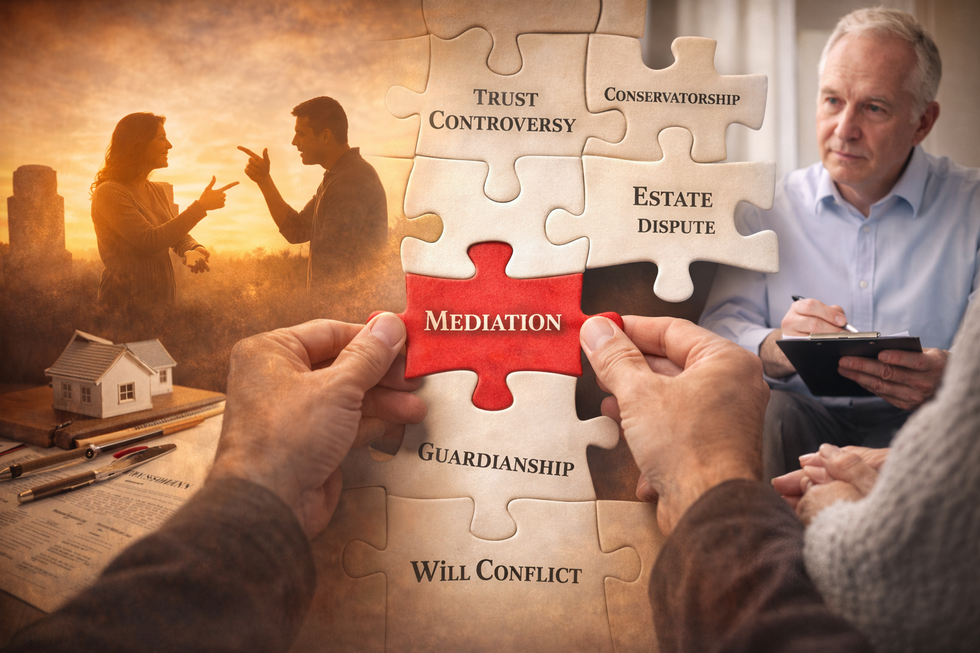
Selecting the Right Probate Mediator
Choosing the mediator can determine success or failure.
Key considerations:
1. Probate Experience
Probate is highly specialized. Knowledge of evidentiary standards, fiduciary duties, and bench trial tendencies is essential.
2. Judicial Insight
Many probate trials are bench trials. A retired probate judge can provide valuable reality-testing based on judicial experience.
3. Style and Personality
Some cases require a direct, evaluative mediator.
Others require a more facilitative, emotionally attuned approach.
Probate mediation often follows death or incapacity — inherently sensitive events. The mediator's demeanor must align with the family's emotional needs.
Preparing Clients for Probate Mediation
Preparation is critical.
A well-prepared client:
- Understands the legal scope of the dispute
- Knows best- and worst-case scenarios
- Recognizes evidentiary strengths and weaknesses
- Enters mediation with realistic expectations
In emotionally charged cases, clients may fixate on grievances unrelated to the legal issue at hand. For example, allegations about caregiving quality may not be relevant in a narrow appointment dispute.
Part of mediation preparation involves clarifying scope and redirecting emotional energy toward productive resolution.
The Importance of a Strong Mediation Brief
An effective mediation brief:
- Summarizes key facts
- Explains legal positions
- Addresses weaknesses candidly
- Identifies settlement possibilities
- Educates the mediator on emotional context
Sharing briefs with opposing counsel can enhance transparency and good faith negotiations. Confidential addenda can address sensitive issues separately.
In probate cases, where flexibility exists in structuring solutions, thoughtful briefing can significantly increase resolution chances.
The Intangible Factors in Probate Mediation
While probate disputes involve money, they often center on:
- Control
- Sentimentality
- Recognition
- Perceived fairness
- Long-standing sibling rivalry
- Validation
Mediation allows creative solutions not available in court, such as:
- In-kind property distributions
- Rotating administrator roles
- Structured buyouts
- Staggered distributions
- Formal apologies or acknowledgments
Litigation tends to harden positions. Mediation can restore communication and preserve relationships.
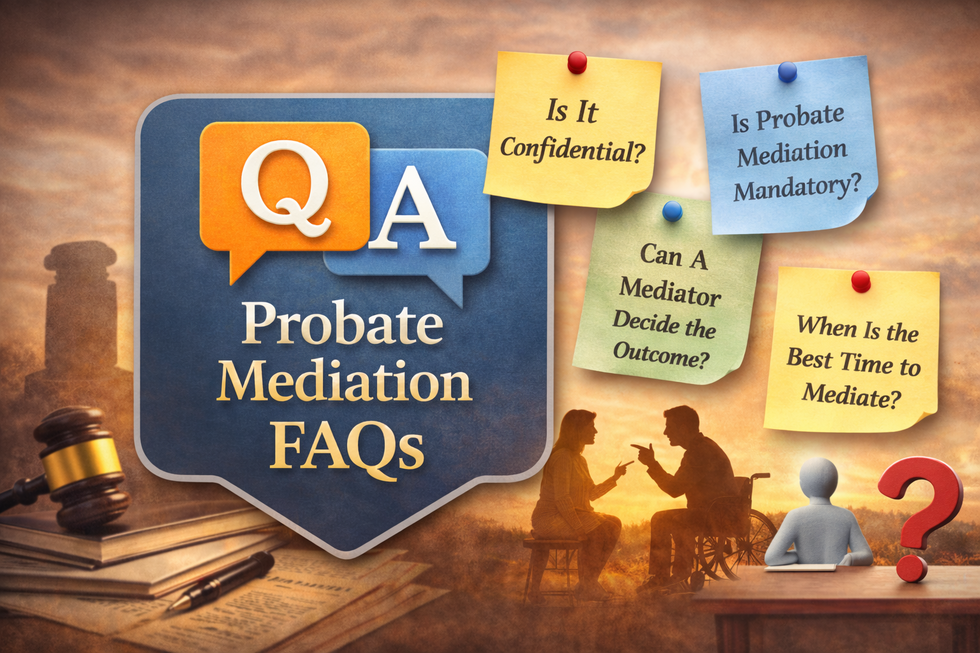
Frequently Asked Questions About Probate Mediation
Q1: Is probate mediation mandatory in California?
It can be. Under Breslin v. Breslin, probate courts may order mediation. Attendance can be mandatory, even if settlement remains voluntary.
Q2: What happens if someone refuses to attend a court-ordered probate mediation?
Failure to attend may result in forfeiting the right to object to the outcome, including potential exclusion from trust benefits.
Q3: Is probate mediation confidential?
Yes. Mediation discussions are confidential and generally inadmissible in court.
Q4: How long does probate mediation take?
Most mediations last a full day. Complex cases may require multiple sessions.
Q5: Can probate mediation address elder abuse allegations?
Yes. Financial elder abuse claims are frequently mediated, particularly where family members dispute fiduciary conduct.
Q6: Should we mediate before filing a petition?
Sometimes. Early mediation can save significant attorney's fees when facts are largely known. However, in capacity or undue influence cases, discovery may be necessary first.
Q7: What if emotions are too high for productive discussion?
That is precisely why mediation can help. Skilled mediators manage emotional intensity through structured caucuses and controlled communication.
Q8: Does mediation mean we are giving up our legal rights?
No. Mediation is non-binding unless a written settlement agreement is executed.
Q9: Who should attend probate mediation?
All interested parties should attend — including trustees, beneficiaries, personal representatives, and sometimes non-litigating interested parties if ordered by the court.
Q10: Is probate mediation cheaper than litigation?
Almost always. Probate litigation can consume a significant portion of the estate. Mediation typically resolves disputes faster and at lower cost.
Final Thoughts
Probate disputes arise at the most vulnerable times in families' lives. Litigation often magnifies grief and entrenches division.
Mediation offers:
- Privacy
- Efficiency
- Cost control
- Emotional space
- Creative problem-solving
- Preservation of family relationships
Every probate matter is unique. The right strategy depends on the facts, the evidence, and the emotional dynamics at play.
If you are navigating a contested estate, trust dispute, or conservatorship matter in California, mediation may offer a path forward that protects both assets and relationships.
At SoCal Mediation, we bring decades of litigation experience into the mediation room — not to escalate conflict, but to resolve it strategically, respectfully, and effectively.
If you would like to explore whether probate mediation is appropriate for your situation, contact our office to schedule a confidential consultation.
See Also:

Comments
There are no comments for this post. Be the first and Add your Comment below.
Leave a Comment