
One of the most common questions people have when considering divorce mediation is simple: what actually happens in mediation? For many couples, the uncertainty surrounding the process creates anxiety and hesitation, even when they want to avoid court.
Divorce mediation is not a single meeting where everything is decided at once. It is a structured, step-by-step process designed to help spouses make informed decisions in a thoughtful and organized way. Each stage builds on the one before it, allowing couples to address emotional, financial, and legal issues without the pressure and hostility of litigation.
Understanding how mediation works can help you decide whether it is the right approach for your divorce and what to expect along the way.
The Agreement to Mediate and the First Session
Divorce mediation begins with an agreement to mediate. This written agreement confirms that the mediator is neutral, explains confidentiality, and establishes that participation in mediation is voluntary. It also outlines the mediator's role and the basic rules that will guide the process.
The first mediation session is primarily an orientation session. The mediator explains how mediation works, what future sessions will look like, and how decisions are typically made. This session is not focused on resolving disputes. Instead, it sets expectations and creates a framework for productive discussions.
During this first meeting, the mediator gathers general background information about the marriage, family, and major issues that need to be resolved. The mediator may also assign tasks, such as completing financial worksheets or gathering documents, to prepare for the next stage of mediation.
The Information-Gathering Stage
The information-gathering stage is the foundation of effective divorce mediation. In order to negotiate a fair and durable agreement, both spouses must have a clear understanding of the relevant facts.
During this stage, spouses exchange financial information such as tax returns, bank statements, mortgage documents, retirement account statements, and records of debts. The mediator may ask each spouse to prepare summaries of income, expenses, assets, and liabilities using standardized worksheets.
If information is missing, unclear, or disputed, the mediator helps the spouses determine how to obtain reliable data. This might involve contacting financial institutions, obtaining appraisals, or consulting neutral experts. The goal is not to resolve disagreements about the past, but to establish accurate information for making decisions going forward.
Mediators often encourage spouses to agree to disagree about past events when resolving those disputes is not necessary to move the process forward. This helps keep mediation focused on present facts and future solutions.
Why the Information-Gathering Stage Takes Time
Many people feel impatient during this stage, especially if they believe they already know what outcome they want. However, rushing through information gathering can lead to incomplete or unworkable agreements that create problems later.
This stage protects both spouses by ensuring transparency and informed decision-making. It also helps balance situations where one spouse handled most of the finances during the marriage while the other did not. Taking the time to fully understand the financial picture often leads to more stable and sustainable agreements.
The Framing Stage: Identifying Interests
Once the factual groundwork is complete, mediation moves into the framing stage. In this stage, the mediator helps each spouse identify their interests, meaning the underlying reasons, priorities, and concerns that shape what they want.
An interest is different from a position. A position is what someone says they want, such as selling the house or keeping it. An interest explains why that outcome matters, such as financial security, stability for children, or the ability to move forward independently.
The mediator helps each spouse articulate their interests for each major issue, including property division, child custody, child support, and spousal support. These interests are often summarized so they can guide negotiations later in the process.
Identifying interests frequently reveals areas of overlap, even when spouses disagree on specific outcomes. These shared concerns often become the foundation for settlement.
Interest-Based Negotiation and Why It Works
Divorce mediation relies on interest-based negotiation rather than win-lose bargaining. Instead of treating divorce as a zero-sum contest, this approach focuses on finding solutions that address the most important concerns of both spouses.
While compromise is often necessary, agreements reached through interest-based negotiation tend to feel more balanced and acceptable. This approach also allows for more creative and flexible solutions than those typically available through court orders.
The Negotiating Stage
After interests are clearly identified, mediation moves into the negotiating stage. This stage usually begins with brainstorming possible options for resolving each issue.
During brainstorming, the mediator encourages creativity and temporarily suspends judgment. All ideas are listed without immediate evaluation, even those that may seem unrealistic at first. This process expands the range of possible solutions beyond the limited options usually available in court.
Once brainstorming is complete, the mediator helps the spouses evaluate each option against their stated interests. Clearly unworkable options are eliminated, while promising options are refined, combined, or adjusted through discussion.
Negotiation often involves trade-offs across different issues. An option that benefits one spouse more on one issue may be balanced by an option that benefits the other spouse on a different issue. The mediator helps ensure that these trade-offs remain aligned with the interests identified earlier.
Moving Back and Forth Between Stages
It is common during negotiation to return briefly to earlier stages of mediation. New options may require additional information, or discussions may reveal interests that were not previously identified.
Although this can feel like moving backward, revisiting earlier stages often leads to stronger and more complete agreements. This flexibility is a feature of mediation, not a flaw.
Reaching a Tentative Agreement
As negotiations progress, spouses begin narrowing their options and shaping a tentative overall agreement. At this point, the mediator summarizes the proposed settlement and identifies any assumptions that need to be verified, such as financing qualifications or tax implications.
Agreements at this stage are usually tentative until necessary information is confirmed. This allows both spouses to move forward carefully without committing to terms that later prove unrealistic or unworkable.
The Concluding Stage and the Written Agreement
Once both spouses are satisfied that the settlement addresses their interests and is feasible, mediation moves into the concluding stage. The mediator prepares a written memorandum or a full settlement agreement outlining the terms of the resolution.
Both spouses review the document carefully, often with the assistance of consulting attorneys. Revisions at this stage are common and may involve clarifying language, correcting factual errors, or addressing issues that were overlooked.
If substantive changes are requested, additional mediation sessions may be needed to resolve them. The goal is a final agreement that accurately reflects what both spouses intend and can live with long term.
The Role of Consulting Attorneys
Mediation does not prevent either spouse from seeking legal advice. Consulting attorneys can review the agreement, explain legal rights, and ensure that the document is clear and enforceable.
Their role is often described as legal proofreading rather than litigation. Consulting attorneys help ensure that the agreement says what the parties intend it to say and does not create unintended consequences.
Finalizing the Divorce
After the agreement is finalized and signed, it is submitted to the court as part of an uncontested divorce. Court involvement at this stage is minimal and largely administrative, with no trial and limited court appearances.
For many couples, this is a sharp contrast to traditional litigation. Mediation not only resolves legal issues but also promotes more constructive communication, which can be especially important for parents who will continue interacting after divorce.
Why Understanding the Mediation Process Matters
Understanding what happens in divorce mediation helps couples approach the process with confidence. Mediation is not about forcing agreement or rushing decisions. It is a deliberate, step-by-step process designed to help people make informed choices during a difficult transition.
For individuals considering divorce mediation in Los Angeles, knowing these stages can clarify expectations and help determine whether mediation offers the structured, conciliatory alternative they are seeking.
Q&A
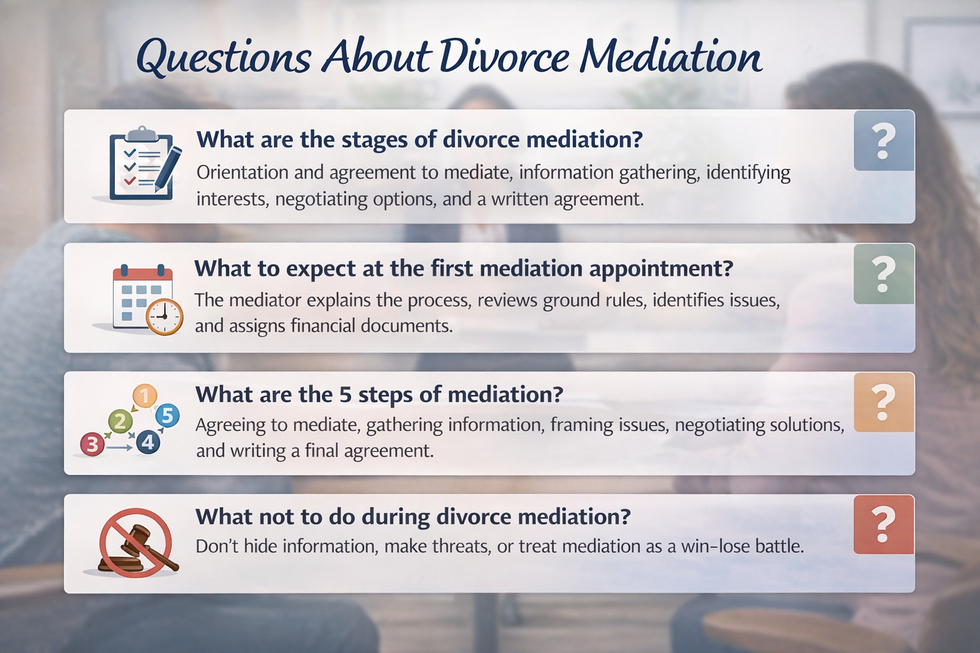
What are the stages of divorce mediation?
The stages of divorce mediation typically include orientation and agreement to mediate, information gathering, identifying issues and interests, negotiating settlement options, and concluding with a written agreement submitted to the court.
What should I expect at the first mediation appointment?
The first mediation appointment focuses on orientation. The mediator explains the process, reviews confidentiality and ground rules, identifies key issues, and assigns financial documents or worksheets. Substantive negotiations usually happen in later sessions.
What are the five steps of mediation?
The five steps of mediation are agreeing to mediate, gathering information, framing issues and interests, negotiating solutions, and finalizing a written settlement agreement. Mediation may move back and forth between steps as needed.
What not to do during divorce mediation?
Do not hide information, make threats, argue past grievances, or treat mediation as a win-lose battle. Mediation works best when both parties participate honestly, listen carefully, and focus on practical, forward-looking solutions.
See Also:

Comments
There are no comments for this post. Be the first and Add your Comment below.
Leave a Comment