
If you are considering divorce, mediation may seem like the obvious choice. It is often less expensive, more private, and less adversarial than going to court.
But here is what many people do not realize:
Mediation is not always the right tool—and in the wrong situation, it can cost you far more than litigation.
In my practice, I have seen individuals walk away from mediation agreements only to later discover they gave up substantial financial rights, misunderstood support obligations, or agreed to terms that were difficult—if not impossible—to reverse.
This guide explains when you should hire a divorce lawyer instead of using mediation in California, and how to avoid the most common and costly mistakes.
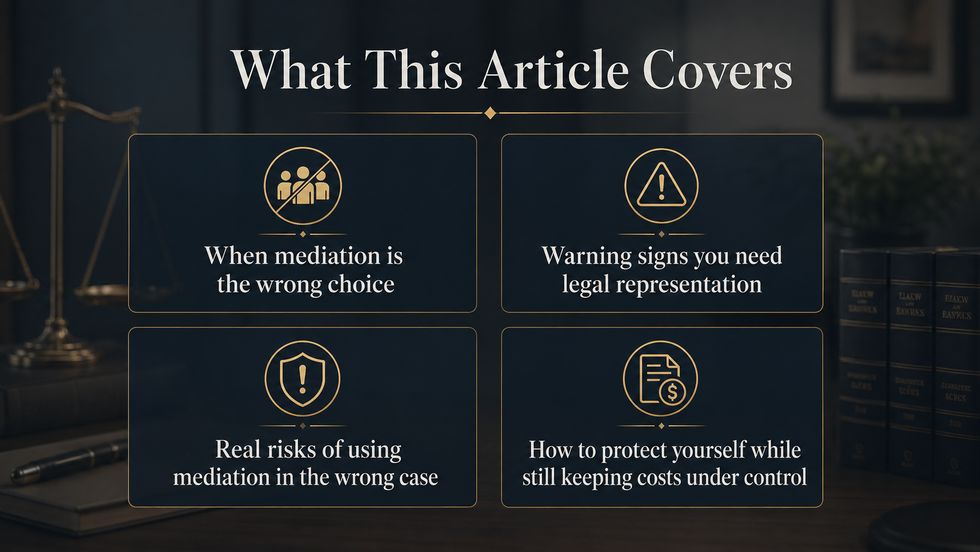
WHAT THIS ARTICLE COVERS
- When mediation is the wrong choice
- Warning signs you need legal representation
- Real risks of using mediation in the wrong case
- How to protect yourself while still keeping costs under control
1. YOU SHOULD HIRE A LAWYER IF YOU DO NOT TRUST YOUR SPOUSE
Mediation depends on voluntary honesty.
Unlike litigation, there is no formal discovery process unless the parties agree to it. That means:
- No subpoenas
- No depositions
- No forced disclosure beyond cooperation
If you suspect:
- Hidden income
- Undisclosed accounts
- Cash businesses or side income
- Missing financial records
Mediation becomes risky.
A divorce lawyer can:
- Conduct formal discovery
- Trace assets
- Compel document production
If trust is low, mediation alone is not enough.
2. YOU NEED A LAWYER WHEN ONE PERSON CONTROLS THE FINANCES
This is one of the most common—and dangerous—situations.
If one spouse:
- Pays all the bills
- Manages investments
- Controls business income
- Handles taxes
The other spouse is at a serious informational disadvantage.
In mediation, that imbalance often leads to:
- Unequal settlements
- Misunderstood asset values
- Improper support agreements
A lawyer levels the playing field by ensuring:
- Full financial disclosure
- Proper valuation of assets
- Accurate understanding of legal rights
3. HIGH-ASSET CASES REQUIRE LEGAL OVERSIGHT
Mediation can work in high-asset cases—but not without structure.
If your divorce involves:
- Real estate portfolios
- Retirement accounts (401(k), pensions)
- Businesses or partnerships
- Stock options or deferred compensation
Then mistakes can be extremely costly.
Common errors in mediation include:
- Improper division of retirement accounts
- Tax consequences being ignored
- Business valuations based on guesswork
In these cases, a lawyer (and often financial professionals) is essential.
4. YOU SHOULD NOT USE MEDIATION IF THERE IS A POWER IMBALANCE
Mediation assumes both parties can:
- Speak freely
- Negotiate effectively
- Say no when necessary
But that is not always reality.
Warning signs include:
- One person dominates conversations
- One party feels pressured to agree
- Emotional or psychological control
- Fear of conflict or retaliation
In these situations, mediation can produce agreements that are technically voluntary—but fundamentally unfair.
A lawyer provides:
- Independent advice
- Protection from pressure
- A buffer in negotiations
5. DOMESTIC VIOLENCE OR INTIMIDATION CHANGES EVERYTHING
If there is any history of:
- Physical abuse
- Threats
- Coercion
- Intimidation
Mediation may not be appropriate.
Even if both parties agree to try mediation, the underlying dynamic can prevent meaningful negotiation.
California courts take these issues seriously, and legal representation is critical to ensure:
- Safety
- Fair process
- Enforceable outcomes
6. YOU NEED A LAWYER IF YOU DO NOT UNDERSTAND YOUR RIGHTS
Many people enter mediation with little understanding of:
- Community property laws
- Spousal support rules
- Child support calculations
- Separate vs. marital property
That creates a dangerous situation.
Because in mediation:
👉 No one is required to explain what you are legally entitled to.
A mediator is neutral. They do not advocate for you.
Without legal guidance, you may:
- Accept less than you are entitled to
- Waive important rights
- Agree to terms you later regret
7. MEDIATION CAN FAIL—AND YOU NEED A BACKUP PLAN
Not every mediation succeeds.
If negotiations break down, you may end up:
- Starting over in litigation
- Spending more money
- Losing time and leverage
Having a lawyer from the beginning ensures:
- You are prepared if mediation fails
- Your strategy is consistent
- You are not starting from scratch
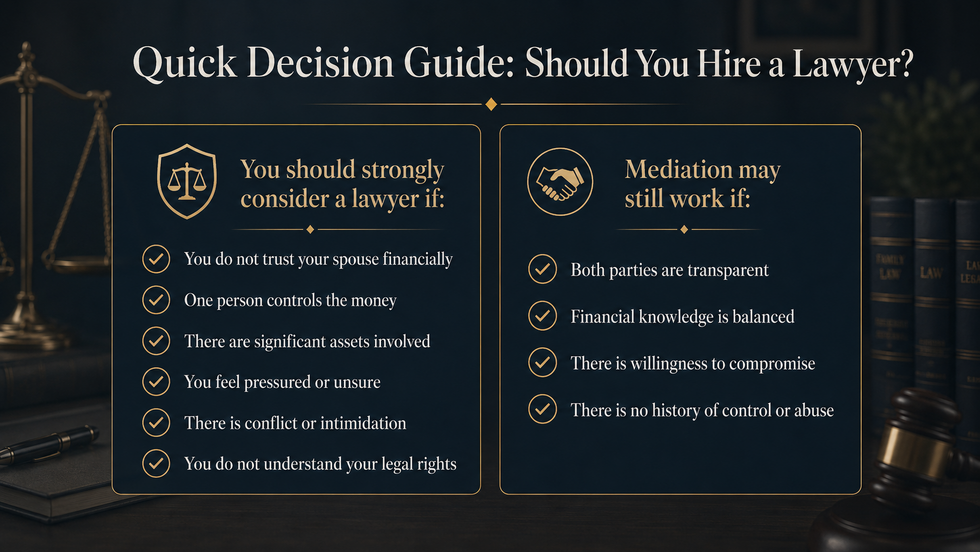
QUICK DECISION GUIDE: SHOULD YOU HIRE A LAWYER?
You should strongly consider a lawyer if:
- You do not trust your spouse financially
- One person controls the money
- There are significant assets involved
- You feel pressured or unsure
- There is conflict or intimidation
- You do not understand your legal rights
Mediation may still work if:
- Both parties are transparent
- Financial knowledge is balanced
- There is willingness to compromise
- There is no history of control or abuse
THE SMART APPROACH: USE BOTH
In many cases, the best solution is not choosing one or the other.
It is combining them.
A common and effective approach is:
- Use mediation to resolve issues
- Have a lawyer review the agreement before signing
This gives you:
- The efficiency of mediation
- The protection of legal advice
COMMON MISTAKES TO AVOID
1. Assuming the mediator will protect you
They will not. That is not their role.
2. Trying to save money upfront
Bad agreements are far more expensive later.
3. Signing too quickly
Once finalized, agreements are difficult to undo.
4. Ignoring financial uncertainty
If something feels unclear, it probably is.

FINAL THOUGHTS
Mediation is a powerful tool—but only when used in the right situation.
If there is trust, transparency, and balance, it can lead to efficient and respectful outcomes.
But when those elements are missing, mediation can expose you to serious financial and legal risk.
The key is not choosing the cheapest or easiest option.
It is choosing the right strategy for your situation.
Comments
There are no comments for this post. Be the first and Add your Comment below.
Leave a Comment